

Yazan Fattaleh
Denver, CO, USA
The following is an artifact in time, an email written to my extended family after visiting our ancestral home in the summer of 2023. My experience of this event has evolved over time, and I’m proud to share my initial recounting of the visit as part of this anthology.
July 2023
Hi Family,
Back in June, I visited our old home in Jerusalem, 3 Uziya St. Instead of being turned away, my partner Emma and I spent an hour with the old woman who lives there.
When we knocked on the door it took her a minute or so to answer, and we were sure to be extra friendly. Emma spoke first. We told her that we were on vacation from the States and that we knew people who used to live there and we wanted to come by and introduce ourselves.
She spoke English well. She was confused at first and asked if we were sure this was the right house. We told her we were pretty sure this was the house because "the people we know told us the address was 3 Uziya Street." She continued trying to help us. "When did your friends live here?" We told her "Some years back..." Finally, she said, "I am just so confused because I have lived here since 1954."
At this point, we had built a little friendly rapport with her. So I took a deep breath and said, "I'm sorry if we've been misleading. I've been nervous to come knock on your door because I am the great-grandson of the Palestinian family who used to live here before 1948." She took a moment and then gave us a big nod and said "Ooooh...now I understand."
Emma was sure to follow up quickly and say that this was a friendly visit. We introduced ourselves and then I asked the woman, Hanna Cohen, if we could look inside because it would really mean a lot to us. Surely enough, she opened the door and welcomed us. She apologized that she hadn't tidied up because, of course, she wasn't expecting company.
We learned that the house was used by the Israeli army during the 1948 war and was then rented for a year or two by a man named Dr. Goodman. She and her husband, newly married, moved in in 1954. They rented the house from the Israeli authority and then saved up money to purchase it a few years later.
She told us that the house was in pretty bad shape after the army used it and that Dr. Goodman wasn't there for long enough to take care of anything. She and her husband tidied it up when they moved in and haven't done any major renovations to it ever since, beyond updating appliances. Specifically, she mentioned that they had replaced the floor. The layout is still the same as it was when our family lived there, except she thinks that the army may have removed a wall dividing the main central room, which she has left open. I think many of the windows may be original, too.
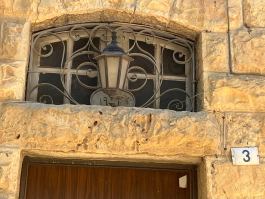
She told me that this house is a "traditional Arabic house" – that the basement was originally used as a cistern to collect water, and that the water pump by the corner of the house was where you could pump up the water from the cistern. This water pump was fondly remembered by my Sido Munir, and referenced often in his stories. She made sure to point out where it reads 1922 in Arabic numbers above the front door, the year the house was built. 101 years ago.
She remembers in the 1970s when Munir (my paternal grandpa) and his mom, Hilaneh, visited the house and her late husband David welcomed them. She recalled that many of the kids immigrated to the States (the San Jose Fattaleh clan) and that there was a pharmacy in Amman that one of the kids started (the Fattaleh Pharmacy, of course).
She did not express any guilt for living in that home, or acknowledge the hurt of us losing the home. She did say that she was very happy to know that our family has done well and that we are successful wherever we may have ended up. I felt a strong implication that she was glad “wherever we may have ended up” was not Palestine. From her perspective the house is hers—she was fleeing a war of her own, paid for the house, raised her family there, and has now lived there for nearly 70 years.
Hanna was born in 1929 in Austria. She and her parents fled Austria when she was 8 years old after the Germans invaded during World War II. She is an only child. I affirmed that that must have been an atrocious experience, and politely asked if she was comfortable to share any more. All she shared was that her entire dad's side of her family was killed in Poland.
While Hanna welcomed us into her home and remained totally available to answer any and all of our questions—truly we did not feel rushed or ushered out at any point—yet we weren't offered a seat or tea. When it became clear that we would be chatting for a while longer, I asked if she may be more comfortable taking a seat. At over 90 years old, it would’ve been perfectly understandable if her feet were hurting. She insisted for us to remain standing. I felt her demeanor was very available, yet guarded.
The interaction was honest. I felt an unspoken understanding that all circumstances that led to our meeting are greatly unfortunate. I’m not happy that she’s there, and I understand why. And I think she didn't love that I was there, but she understood why. At one point in our interaction, she said, "I don't know what you think about this whole situation, or how you feel about me, but what can you do? You could kill me! But you won't kill me."
One of the reasons why I think Hanna let us in and offered her time was because she had been back to Austria in adulthood and visited her childhood home years ago. I told her, "So you understand firsthand the gift you're giving me by letting me spend this time with you in this house." She nodded and said, "I guess that's so."
She has two children, one lives in Jerusalem and the other in Tel Aviv, grandkids, and even 7 great-grandchildren. Her home is utterly grandmotherly. She had decorations on the walls and photos of her family everywhere. She has a love for owls, and any time her grandchildren travel they bring her back a little owl figurine. She has them all on a shelf in her hallway. It reminds me of how my maternal Teta Leila's fridge was decorated with magnets from all the places her grandchildren have traveled over the decades. Unsurprisingly, the similarities are uncanny. My Teta Leila was raised in a house just down the street in the Katamon neighborhood.
I asked Hanna what her kids will say when she tells them she spent the morning with us. "They'd say, ‘Wow! That is very interesting!’ And I will tell them you are very friendly people."
Indeed! We were intentionally being very friendly. You’ll see in the album a photo of Hanna and me standing in front of the house together smiling. It’s odd. This is something I’ve later reflected on. Hanna held the power in this interaction, and I was suspending my full emotion while we were together. It is not an uncommon story for Palestinians in the diaspora to visit Jerusalem and knock on the doors of their families’ old homes. Almost always the door is slammed in their face. Hanna could have done the same. She could have called the police saying we were hassling her. In videos I’ve seen, and stories I’ve heard, the Palestinian’s opening lines are (understandably) unfriendly, to say the least.
Upon reflection, I realized I had committed to remain pragmatic and keep my demeanor palatable from Hanna’s perspective. I wanted to add a new experience to this story. I knew the house was stolen by the state of Israel, and I expected that a Jewish Israeli family lived there. I was right. Since I wanted to know more, this was my opportunity and I was going to get inside that house if at all possible. It was not until much later, with good distance from Jerusalem in general, that the anger, tears, and the insanity of the experience I had began to set in.
There is a synagogue right next door, which feels like it's even on the same plot of land. Hanna told us that the synagogue was very small at first, and then they built a bit more to accommodate the growing congregation. My Dad (Nadim) recently told me that that building was a small one bedroom-type home that Awad and Hilaneh built and rented to Polish Jewish refugees in Jerusalem before 1948. Hilaneh even asked the mother of that family to water their plants when our family fled to Jordan, expecting to be in Jordan just a week or two. “Dorit Naaman’s Jerusalem, We Are Here” project says it was a garage turned 2 bedroom house that was “rented to a barber who was married to a turkish woman from Cyprus” at some point.
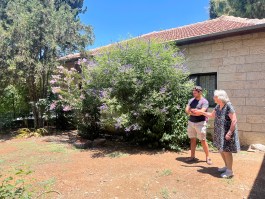
We got to take our time exploring all the rooms in the house and we spent some time walking around the house, too. Hanna pointed out the three original plants. A tree, a rose bush, and a lilac bush in the front yard. They must all be at least 100 years old. I got to walk around the entire house and pop my head in the basement as well. Good photos and a video of this are in the Google Photos album.
This whole experience makes me think about the parallels of how land was violently stolen and coerced away from indigenous Native Americans in the United States. Yet all the relevant authorities have issued me documents that I own my home in Denver, as Hanna does own 3 Uziya St. Of course. It feels different because 1. My ancestors weren't dispossessed on the land I live in now (which is also something Hanna could say) and 2. It's literally the physical bricks that keep the roof over her head. But the broad strokes, power dynamics, and subsequent dispossession in these stories are the same. None of it is okay. It reminds me of this project I learned about a few years back when I was living in London.
I would like to think that if a member of the Ute, Arapaho, or Cheyenne tribe came and knocked on my door in Denver I would take more interest in their perspective than Hanna took in mine–which was not at all.
If you're interested in the Israeli Absentee Law which is the legislation passed that removed our ownership and authorized Israel to rent it to Hanna, you can read more here and here. Especially poignant in its hypocrisy with the recent eviction of this Palestinian family in Jerusalem on the grounds that their house was historically owned by a Jewish organization.
After saying goodbye to Hanna, we visited Sido Awad's old supermarket. It's a restaurant now that cooks food for Shabbat, so they only cook on Thursdays and Fridays for people to take the food home, but they're trying now to expand their offerings. There were two conservative Jewish men behind the counter. We bought a lemonade from their fridge, and Emma asked them how long they'd been there. They said two or three years. "What was here before you?" Emma asked.
"Oh! This is a historic building!" one of the men said, proudly. "A shoe cobbler worked out of here for SIXTY years."
Emma continued, "Wow! That's great. What about before then?"
The two men looked at each other and kinda puffed their lips and basically said, “Oh geez, we have no idea what could've possibly been here before that.” Which of course is coherent with the myth that necessarily justifies Zionism: that the land the British “gave” Zionists was “a land with no people for a people with no land.”
I felt this big impulse and said with gusto, "I can tell you what was here before then."
The men were very taken aback. They looked at me silently.
I felt tunnel vision as I looked them dead in the eyes and proclaimed. "I'm Palestinian. My great-grandfather owned a grocery store right here, right where you are standing." It was a very mic-drop moment.
One of them sank his head and walked to the back of the restaurant. The other was flustered, offered us a seat, and told us to enjoy our lemonade. He took a moment to collect himself and came out to chat with us more, referring to the times before 1948 as Ottoman and British, never saying Palestine. At some point he did say “I don’t think there will ever be peace. We are just too different.” I felt this was quite a convenient opinion for him to hold, living in relatively greater safety than any Palestinian, citizen of Israel or not.
It felt important to assert myself, and now I'm satisfied that they can't un-know this every day when they come to work. Similar to the sentiment at the end of this Instagram video.
This was a huge experience for me, and I'm really happy I get to share it with all of you.
Please Reply All! We're all Jerusalemites, related to Awad and Hilaneh in some way. Our connection to this house connects us with millions of others around the world who have also been hurt through political violence, oppression, forced migration, and dispossession. We are all living examples of the human superpower to survive and thrive.
If there's anybody else that needs to be included in this email let's loop them in!
Hugs,
Yazan

Yazan Fattaleh is the COO at The Village Institute. He has a BA in Economics from the University of Colorado-Boulder and certificates in Monitoring and Evaluation from Makerere University in Kampala and Joining Vision and Action in Denver, CO. In his free time Yazan likes to rock climb, salsa dance, and eat hummus—not all at the same time.